


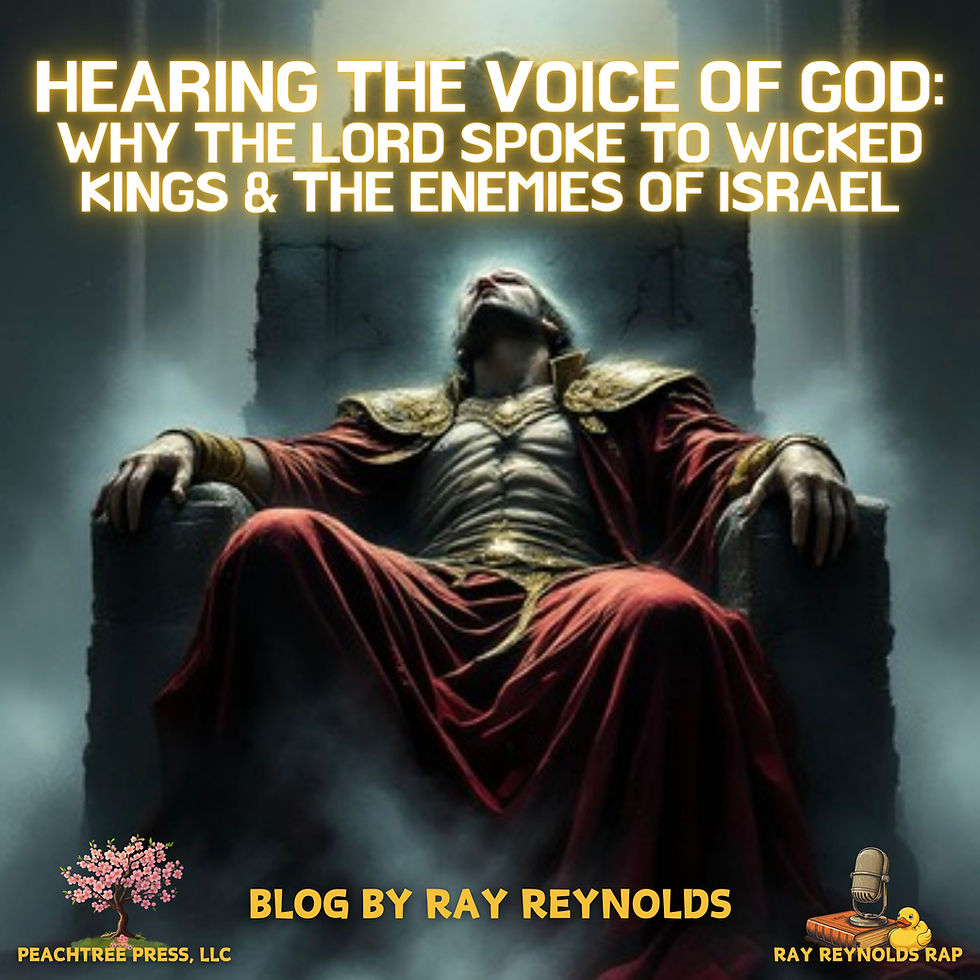
Hearing the Voice of God: Why the Lord Spoke to Wicked Kings & the Enemies of Israel

When we open the pages of Scripture, we naturally expect to find God speaking to His chosen instruments. We look for His voice in the quiet whispers to Elijah, the dramatic burning bush of Moses, or the late-night call to a young Samuel. It is a comforting narrative: the Holy God communicating with holy people, guiding the faithful, and building His kingdom through the righteous.
However, a closer examination of the biblical narrative reveals a startling and disruptive truth. God’s line of communication was never restricted to the borders of Israel, nor was it reserved exclusively for the saints. Why is that? I’m glad you asked.
On Wednesday, July 1, we had a Bible class at our congregation where we discussed this very topic. Jason, one of our gifted Christian brothers, was assigned the text of Daniel 5. Specifically, the handwriting on the wall. He challenged us to carefully examine times in scripture where God spoke directly to someone who was either an enemy of the children of God or a wicked and idolatrous people. I immediately began reading and studying those examples. My research into this subject was limited but now I’m prepared to share my findings.
Throughout history, the Lord repeatedly broke His silence to speak directly to the hostile, the pagan, and the profoundly wicked. From the blood-stained palaces of Samaria to the idol-worshiping courts of Babylon, God spoke to kings who detested His laws and foreign rulers who did not recognize His name.
These divine intrusions were not accidental. They served as cosmic demonstrations of absolute sovereignty, acts of restrictive grace to prevent further evil, and undeniable warnings of impending justice. When we organize these encounters chronologically, we discover a sweeping historical tapestry showing that no ruler is too powerful to ignore God's voice, and no heart is too distant to be reached by His word.
I. King Abimelech of Gerar (c. 2000 BC)
The Warning of Restraining Grace - Genesis 20:3–7
Long before Israel existed as a formal nation with a line of monarchs, God was already laying down the law to foreign kings. The first explicit account of God speaking to a Gentile ruler occurs in the dusty kingdom of Gerar. Abraham, gripped by fear, had lied about his wife Sarah, claiming she was merely his sister. Taking the patriarch at his word, King Abimelech brought Sarah into his royal harem.
Abimelech was not a worshiper of Yahweh, yet God did not leave him to his own devices. God breached the pagan king’s sleep, appearing to him in a vivid, terrifying dream: "Yes, I know that you did this in the integrity of your heart. For I also withheld you from sinning against Me; therefore I did not allow you to touch her." (Genesis 20:3)
What follows is an incredible dialogue. Abimelech, pleading his innocence based on the misinformation he was given, asked if God would destroy a blameless nation. God responded by validating the king's integrity in this specific matter, revealing a profound theological truth: God’s voice often operates as an instrument of restraining grace.
Through this direct, nighttime confrontation, God protected the lineage that would eventually bring forth the Messiah, proving that He can and will command the conscience of a Gentile king to fulfill His ultimate redemptive purposes.
II. Pharaoh of Egypt (c. 1890 BC)
The Revelation of Global Sovereignty - Genesis 41:1–32
Centuries later, the focal point of divine communication shifted to the most powerful empire of the ancient world: Egypt. Pharaoh, considered a living deity by his subjects, found his absolute authority shattered by two vivid, deeply unsettling nightmares. In one, seven gaunt, diseased cows devoured seven plump, healthy cows. In the second, seven scorched heads of grain swallowed seven healthy ones.
When the magicians and wise men of Egypt failed to decode the dreams, a Hebrew prisoner named Joseph was brought from the dungeons. Joseph immediately corrected any notion that these dreams were a byproduct of a restless mind or local Egyptian deities: "God has shown Pharaoh what He is about to do.." (Genesis 41:25).
By sending these twin prophetic dreams, Yahweh was directly speaking to the head of a massive pagan empire. God was not asking for Pharaoh's permission; He was announcing a regional, catastrophic seven-year famine. Through this divine broadcast, God forced the ruler of Egypt to acknowledge a higher power, elevated Joseph to the position of prime minister, and preserved the nation of Israel from starvation.
III. King Jeroboam I of Israel (c. 930 BC)
The Shattered Altar of Compromise - I Kings 12-14
Following the golden eras of David and Solomon, the kingdom of Israel fractured. Jeroboam I assumed control of the northern ten tribes and, driven by political insecurity, committed a catastrophic sin. To prevent his citizens from traveling south to Jerusalem to worship, he manufactured a counterfeit religion, erecting golden calves at Dan and Bethel. He became the prototype of the wicked king, earning the tragic scriptural epitaph: "Jeroboam, who caused Israel to sin."
Despite Jeroboam's rapid apostasy, God did not abandon the northern kingdom to silence. As Jeroboam stood by his unauthorized altar at Bethel to burn incense, an unnamed prophet of God arrived with a direct, thunderous message from heaven.
The prophet cried out against the very stones of the altar, predicting that a future descendant of David named Josiah would burn the bones of the false priests upon it. Infuriated, Jeroboam stretched out his hand, shouting, "Seize him!"
Instantly, God spoke through physical judgment: the king’s arm withered and dried up, paralyzing him on the spot, while the pagan altar split apart, spilling its ashes. God later spoke to Jeroboam a second time through the aging, blind prophet Ahijah, delivering a devastating sentence of doom upon his entire household because he had cast God behind his back.
IV. King Ahab of Israel (c. 870 BC)
Confrontations in the Vineyard of Blood - I Kings 17–22
If Jeroboam introduced institutional idolatry to Israel, King Ahab and his Phoenician queen, Jezebel, perfected it. Ahab did more to provoke the Lord to anger than all the kings of Israel before him, replacing the worship of Yahweh with the state-sponsored cult of Baal.
Because Ahab’s rebellion was loud and aggressive, God's voice to him was equally unmistakable and relentless. God spoke to Ahab primarily through the prophet Elijah. Their relationship was defined by fiery divine confrontations. God spoke through a three-year drought that paralyzed Ahab's kingdom, broke the silence with fire falling from heaven on Mount Carmel, and cornered Ahab in the wake of a horrific crime.
After Jezebel orchestrated the murder of a righteous man named Naboth just so Ahab could seize his family vineyard, Ahab went down to claim his prize. There, standing among the stolen vines, was Elijah. The voice of God broke through the prophet with terrifying precision: "Have you murdered and also taken possession?... In the place where dogs licked the blood of Naboth, dogs shall lick your blood, even yours." (I Kings 21:19)
Ahab’s response was immediate; he tore his clothes, wore sackcloth, and fasted. In a stunning display of mercy, God spoke to Elijah again, acknowledging Ahab's temporary humility and delaying the full measure of the family’s destruction. Even to a king as deeply corrupt as Ahab, God’s voice remained available, holding him accountable for every drop of innocent blood.
V. King Ahaz of Judah (c. 735 BC)
The Spurned Offer of Grace - Isaiah 7:1–13
While the northern kingdom plummeted into darkness, the southern kingdom of Judah encountered its own crises of leadership. King Ahaz was remarkably wicked; he walked in the ways of the kings of Israel, made cast idols for the Baals, and shockingly sacrificed his own children in the fires of the Valley of Hinnom.
When the kings of Aram and northern Israel allied to march against Jerusalem, Ahaz was paralyzed with fear. Instead of seeking Yahweh, his heart turned toward an alliance with the ruthless empire of Assyria.
In this moment of profound infidelity, God did something completely unexpected: He sent the prophet Isaiah to meet Ahaz face-to-face. God spoke to this wicked king, telling him to remain calm and not to fear the invading armies, promising that their plots would fail. Then, God extended an unprecedented offer: "Ask a sign for yourself from the Lord your God; ask it either in the depth or in the height above." (Isaiah 7:11)
God offered to split the heavens or tear open the earth just to prove His trustworthiness to an idol-worshiping king. Ahaz, masking his stubborn unbelief with a coat of false piety, refused, saying, "I will not ask; I will not put the Lord to the test."
Though Ahaz rejected the conversation, God spoke right past his stubbornness, delivering the historic, momentous Immanuel prophecy: "Therefore the Lord Himself will give you a sign: Behold, the virgin shall conceive and bear a Son, and shall call His name Immanuel." (Isaiah 7:14). Ahaz wanted a political treaty, but God used the encounter to announce the ultimate arrival of the Savior of the world.
VI. King Nebuchadnezzar of Babylon (c. 605–562 BC)
The Humbling of the Great Tree - Daniel 2–4
Perhaps the most extensive, dramatic dialogues between Yahweh and a foreign ruler occurred during the Babylonian exile. King Nebuchadnezzar was a brutal, prideful, conqueror who destroyed Jerusalem, burned the temple, and carried God's people into captivity. He viewed himself as the undisputed master of the known world.
Yet, God repeatedly invaded Nebuchadnezzar's consciousness. First, God sent him a dream of a massive, multi-layered statue composed of gold, silver, bronze, iron, and clay, which was smashed to pieces by a supernatural rock. When Daniel interpreted this as the rise and fall of human empires bowing eventually to the eternal Kingdom of God, Nebuchadnezzar fell on his face, momentarily acknowledging that Daniel's God was the "God of gods."
However, pride is a stubborn root. Years later, God spoke to him again through another dream—a massive, fruit-bearing tree that was chopped down to a stump. Daniel warned the king that this represented his own imminent downfall unless he renounced his sins and showed mercy to the oppressed.
Nebuchadnezzar ignored the warning. Twelve months later, as he walked on the roof of his palace, boasting, "King Nebuchadnezzar, to you it is spoken: the kingdom has departed from you! And they shall drive you from men, and your dwelling shall be with the beasts of the field.." (Daniel 4:31–32)
Instantly, the divine decree was fulfilled. The mighty emperor suffered a period of severe mental illness, living like an animal in the fields until his seven years of isolation were complete. When his sanity returned, Nebuchadnezzar did not praise Marduk or Ishtar; he raised his eyes to heaven and praised Yahweh, writing a public decree honoring the King of heaven.
VII. King Belshazzar of Babylon (c. 539 BC)
The Handwriting on the Wall - Daniel 5:5–31
Where Nebuchadnezzar learned humility, his successor, King Belshazzar, chose reckless arrogance. During a massive, decadent banquet for a thousand of his lords, Belshazzar committed a profound act of sacrilege. He ordered his servants to bring out the gold and silver chalices that his predecessor had plundered from the temple of God in Jerusalem.
As the king, his noblemen, and his wives drank wine from these sacred vessels while praising their gods of gold, silver, bronze, iron, wood, and stone, the atmosphere in the banquet hall suddenly froze.
God did not speak to Belshazzar through a gentle whisper or a dream in the night. He spoke through a terrifying, highly public visual manifestation. A disembodied human hand emerged in the lamplight, writing four cryptic words into the plaster of the palace wall: MENE MENE TEKEL PARSIN.
The king’s face turned pale, his knees knocked together, and his legs gave way. When Daniel was brought in to translate the divine script, he delivered an uncompromising message of final judgment: MENE or numbered meant God had numbered the days of the kings reign and brought it to an end. TEKEL or weighed meant the king has been weighed on the scales and found wanting. PERES / PARSIN or divided meant his kingdom would be divided and given to the Medes and Persians.
There was no call to repentance here, no room for negotiation, and no delay. God’s voice to Belshazzar was a final sentence. That very night, the Medes breached the city walls, Belshazzar was slain, and the Babylonian empire collapsed into the pages of history.
VIII. King Darius the Mede (c. 539 BC)
The Sovereign Witness - Daniel 6
Following the fall of Babylon, Darius the Mede assumed control of the region. While Darius was not explicitly malicious like Belshazzar, he allowed his vanity to trap him into signing a decree that prohibited prayers to anyone but himself for thirty days. This law directly targeted the devotion of Daniel, forcing Darius to cast his most trusted administrator into a pit of hungry lions.
Darius spent a sleepless, miserable night fasting. At dawn, he rushed to the mouth of the den, crying out in anguish to see if Daniel's God had preserved him. When Daniel answered unharmed, explaining that God had sent His angel to shut the mouths of the lions, the impact on Darius was profound.
While Scripture does not record an audible voice echoing from heaven directly to Darius's ears, God spoke loudly to the king through the miraculous survival of His servant. The raw demonstration of supernatural power was a message Darius could not ignore.
After Daniel’s delivery from the north of the lions, Darius immediately issued a royal decree to every nation, language, and people across his entire empire: "I make a decree that in every dominion of my kingdom men must tremble and fear before the God of Daniel. For He is the living God, and steadfast forever; His kingdom is the one which shall not be destroyed, and His dominion shall endure to the end." (Daniel 6:26) Through this dramatic deliverance, God turned a pagan king's court into a megaphone for His global, everlasting praise.
IX. King Cyrus the Great of Persia (c. 539–538 BC)
The Prophesied Shepherd - Isaiah 45:1–13, Ezra 1:1–4
One of the most remarkable examples of God communicating with a foreign ruler involves Cyrus the Great of Persia. Remarkably, Yahweh spoke about Cyrus through the prophet Isaiah nearly 150 years before the Persian king was even born, calling him by name: "Who says of Cyrus, ‘He is My shepherd, and he shall perform all My pleasure’... Thus says the Lord to His anointed, to Cyrus, whose right hand I have held—to subdue nations before him... I have even called you by your name; I have named you, though you have not known Me." (Isaiah 45:1, 4)
When Cyrus finally conquered Babylon and ascended the throne, the book of Ezra records that the Lord directly "stirred up the spirit of Cyrus king of Persia" to fulfill this ancient word. Therefore, God reached into the mind of this ruler, prompting him to issue a historic written decree throughout his entire realm.
Cyrus acknowledged that the Lord, the God of heaven, had given him all the kingdoms of the earth and had explicitly charged him to build a temple for Him at Jerusalem. Through this divine stirring, Cyrus released the Jewish exiles, funded their return journey, and initiated the rebuilding of Jerusalem.
X. King Manasseh of Judah (c. 687–642 BC)
The Voice that Pierced Thorns - II Chronicles 33:1–20
Returning to the line of Judah’s kings brings us to Manasseh, arguably the most wicked ruler to ever sit on David's throne. Manasseh actively systematically tore down the reforms of his godly father, Hezekiah. He built altars to the stars inside the temple of Yahweh, practiced sorcery, consulted mediums, and sacrificed his own sons in the valley of Ben Hinnom.
The historical account in II Chronicles notes a tragic detail: "And the Lord spoke to Manasseh and his people, but they would not listen." (II Chronicles 33:10). God did not immediately strike him down; He spoke warnings first, extending opportunities for correction that were met with total indifference.
Because Manasseh refused to listen to God’s spoken word, the Lord spoke through the harsh realities of judgment. God permitted the Assyrian army to invade Judah. They captured Manasseh, put a hook through his nose, bound him with bronze shackles, and dragged him off to captivity in Babylon.
It was there, stripped of his crown, sitting in a foreign dungeon with a hook in his face, that the voice of God finally broke through his pride. Manasseh humbled himself greatly and cried out to the God of his ancestors. In a stunning testament to the depth of divine mercy, God heard his prayer, pitied his plight, and restored him to his throne in Jerusalem.
Manasseh spent the rest of his days tearing down the very idols he had built, proving that even the most corrupt heart can be reclaimed when it finally stops ignoring the voice of God. This story, of course, is unlike the others in this list. It is also reminiscent of the people of Nineveh who repented at the preaching of Jonah. Though they didn’t hear the voice of God, they did submit to the Lord through the prophecy of Jonah.
XI. Pharaoh Neco of Egypt (c. 609 BC)
The Divine Battlefield Warning - II Chronicles 35:20–24
The final chronological encounter occurs toward the twilight of the southern kingdom of Judah. Pharaoh Neco of Egypt was marching his massive army northward toward the Euphrates River to assist the collapsing Assyrian empire against Babylon. King Josiah, a reforming and generally righteous king of Judah, made the fatal political mistake of leading his own army out to intercept Neco at Megiddo.
Pharaoh Neco sent messengers directly to Josiah with an explicit, urgent warning, stating clearly that he had no quarrel with Judah: "What have I to do with you, king of Judah? I have not come against you this day, but against the house with which I have war; for God commanded me to make haste. Refrain from meddling with God, who is with me, lest He destroy you." (II Chronicles 35:21)
The biblical writer notes an essential detail: Neco’s words were not empty wartime propaganda; they were genuinely "from the mouth of God." Yahweh was using an Egyptian Pharaoh as His prophetic mouthpiece to warn a king of Judah.
Tragically, Josiah refused to listen. He disguised himself, joined the battle anyway, and was struck down by Egyptian archers, dying a premature death because he failed to recognize that God was speaking through an enemy general.
The Sovereign Lord of Every Throne
The expansive history of God speaking to wicked kings and foreign adversaries shatters any fragile theological box that seeks to confine His activity to the church, the temple, or the hearts of the faithful. These accounts leave us with three inescapable conclusions about the nature of God's voice:
*God holds absolute monopoly over human authority. The kings of the ancient world held unmatched power, yet God disrupted their sleep, intervened in their military strategies, and overrode their decrees. As Proverbs 21:1 beautifully notes, "The king’s heart is in the hand of the Lord, like the rivers of water; He turns it wherever He wishes."
*Divine communication carries distinct purposes. To the proud like Nebuchadnezzar and Belshazzar, His voice brought humbling and final justice. To the salvageable like Manasseh and Abimelech, it arrived as a stern warning wrapped in restraining grace. To rulers like Cyrus, it served as a divine commission to orchestrate the broader plans of biblical history.
*God values real accountability over superficial privilege. God did not give wicked kings a pass just because they sat on foreign thrones or wore royal crowns. He held them completely accountable to His moral law, demonstrating that no human system of power is insulated from the oversight of Heaven.
What About Free Will & Free Moral Agency?
A central theme of biblical history is God’s ability to utilize the actions of wicked individuals to accomplish His divine purposes without ever overriding or violating their human free will. He spoke to them. He allowed them to be hardened in their heart. And He did all this against His own people as a means of discipline.
God achieves this primarily through providential containment and redirection, rather than internal coercion. He does not force a righteous person to become evil, nor does He manufacture wicked desires within a clean heart. Instead, God takes the existing, freely chosen rebellion of corrupt rulers and directs the timing, scope, and consequences of their actions toward His ultimate goals.
First, there is the redirection of existing intentions. God channels human choices much like an engineer channels a wild river. The water flows under its own gravity, but its path is guided. Rulers freely choose to act out of pride, malice, or greed. God simply steps in to determine where that chosen malice lands. (Proverbs 21:1 ).
Second, consider the restraint of evil boundaries.
Wicked kings possess the free will to plot vast destruction, but God exercises absolute sovereignty over their operational limits. He allows them to execute their plans only as far as they serve a broader judicial or redemptive purpose, placing a hard ceiling on the rest. As Psalm 76:10 reveals: "Surely the wrath of man shall praise You; With the remainder of wrath You shall gird Yourself."
Finally, there is the ultimate accountability everyone must face (Hebrews 9:27). If God violated a king's free will by forcing them to commit an evil act, He could not justly punish them for it. Because their choices remain entirely their own, God holds them completely accountable for the wicked motives driving their actions, even when those actions accidentally fulfill prophecy. A prime example is the Assyrian empire, which God used to discipline Israel. Isaiah 10:5–7 captures this tension perfectly, as God warns the empire that He will punish them for their proud hearts, because they did not intend to serve Him; they merely intended to destroy.
Through this flawless interplay of human responsibility and sovereign foresight, God remains entirely holy, humanity remains entirely free, and the grand narrative of scripture moves forward exactly as orchestrated. This is not predestination. Instead it’s about the All-Knowing God we serve.
You are loved.
Ray Reynolds


Comments