


Barnabas: The Son of Encouragement

We live in a culture obsessed with the "self-made" narrative. We celebrate the disruptors, the solo founders, and the spotlight-grabbers. Our social feeds are meticulously curated galleries of personal achievement. But if you look closely at the architecture of any great movement, historical or modern, you will find that it rarely rests solely on the shoulders of its most vocal leaders. It is built on the quiet, fierce generosity of people who are content to be scaffolds rather than towers.
Two thousand years ago, during the explosive and chaotic infancy of the early Christian movement, one man emerged as the ultimate scaffold.
His birth name was Joseph, a Levite from the island of Cyprus. But the people who knew him best looked at his life, his character, and his supernatural capacity to lift others up, and decided his name didn't fit. They rebranded him. They called him **Barnabas**, which translates literally to "Son of Encouragement.”
Barnabas was not the most eloquent theologian of his day—that was Paul. He was not the foundational rock—that was Peter. But without Barnabas, the stories of Paul and Peter might have read very differently. Barnabas possessed a rare, multifaceted generosity that went far beyond writing checks. He gave his wealth, his reputation, and his power away so that others could thrive.
By dissecting how he lived, we find a blueprint for a type of generosity that our deeply fractured modern world desperately needs.
1. Radical Liquid Generosity (Giving Material Wealth)
The world first meets Barnabas in the Book of Acts, specifically at a moment of acute socioeconomic crisis. The early church in Jerusalem was growing exponentially, but it was comprised heavily of the marginalized, widows, and displaced people.
Barnabas did not offer empty platitudes or hollow prayers. He looked at his asset portfolio and took decisive action.
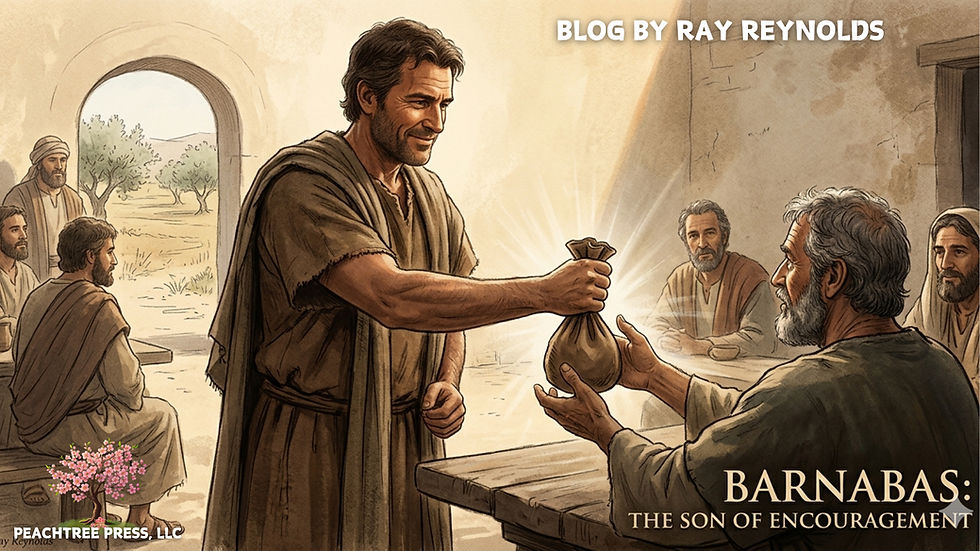
"Joseph, a Levite from Cyprus, whom the apostles called Barnabas (which means ‘Son of Encouragement’), sold a field he owned and brought the money and put it at the apostles’ feet." — Acts 4:36-37
To understand the weight of this act, we have to look past the Sunday-school simplicity of the text. Barnabas was a Levite from Cyprus. Cyprus was a wealthy agricultural and mining hub in the Mediterranean. As a Levite, owning land was historically complicated due to ancestral laws, meaning this field was an incredibly valuable, likely hard-won piece of private property. It represented his financial security, his retirement plan, and his status.
Barnabas did not just give from his surplus; he liquidated his security. He converted a permanent asset into immediate, fluid relief for people who could never pay him back.
True material generosity is inconvenient. It moves past "budgeted charity"—the comfortable pocket change we give after our lifestyle is fully funded—and enters the realm of sacrifice. Barnabas didn't micro-manage his donation or demand a naming right on a building. He laid it at the apostles' feet, relinquishing control because he trusted the community's vision more than he valued his own financial comfort.
2. Social Relational Generosity (Giving Away Reputation)
While giving money is difficult, giving away social capital is often much harder. Your reputation is your currency in society. It dictates your safety, your influence, and your acceptance.
Not long after Barnabas sold his field, a massive political shift occurred. Saul of Tarsus—the chief persecutor of the early church, a man complicit in the execution of believers—claimed to have had a vision of Jesus on the road to Damascus. He changed his life and tried to join the disciples in Jerusalem.
Understandably, the disciples were terrified. They thought it was a trojan horse operation. They rejected Saul.
Enter Barnabas. While everyone else drew back in self-preservation, Barnabas stepped forward. He took Saul by the hand, walked him into the inner circle of leadership, and vouched for him. Barnabas staked his own hard-earned credibility on a man everyone else deemed radioactive. He essentially told the leadership, "If you don't trust Saul, trust me. I will stand security for his character."
We live in an era dominated by "cancel culture" and tribal polarization. It is safe to stay within our echo chambers and defend our clean reputations. Relational generosity means using your privilege and credibility to build a bridge for someone else. It means being willing to get your hands dirty by associating with the misunderstood, the redeemed outcast, or the person whom society has written off. Barnabas saw potential where others saw a threat.
3. Positional Generosity (Giving Away the Spotlight)
Perhaps the rarest form of generosity Barnabas displayed was his willingness to willingly cede power and status. As the church expanded into Antioch—a thriving, multicultural metropolitan city—the Jerusalem leadership sent Barnabas to oversee the movement. Barnabas arrived and saw a massive revival taking place. It was a historic success. A lesser leader would have stayed to consolidate power, build their personal brand, and bask in the adulation.
Instead, Barnabas realized the job was bigger than him. He remembered Saul, who was sitting in obscure isolation in his hometown of Tarsus. Barnabas left his booming church, traveled to Tarsus, tracked Saul down, and brought him back to Antioch to co-lead.
Notice the subtle but profound shift that happens in the biblical narrative after this event:
Before Antioch, the text regularly refers to the duo as "Barnabas and Saul." Barnabas is the senior leader; Saul is the protege. After Antioch, as they embark on missionary journeys, the phrasing permanently flips to “Paul and Barnabas."
Barnabas deliberately stepped into the shadows so that Paul’s superior theological and oratorical gifts could shine. He did not suffer from the fragile ego or professional jealousy that poisons so many modern organizations. He practiced positional generosity—he opened the door, handed over the keys, and cheered from the passenger seat.
The Economics of Encouragement
What happens when we live like Barnabas? We create a compounding interest of grace. Because Barnabas gave his money, the early poor were fed. Because Barnabas gave his reputation, Paul was accepted. Because Paul was accepted, half of the New Testament was written, and Western civilization was irrevocably altered.
Later in his life, Barnabas did it again. When a young assistant named John Mark abandoned their mission team out of fear, Paul refused to work with him again. The argument was so sharp that Paul and Barnabas split up. Paul chose a new partner, but Barnabas took John Mark, patient as ever, and invested in him.
Years later, a mature Paul would write from a Roman prison: “Get Mark and bring him with you, because he is helpful to me in my ministry." Even Paul eventually had to admit that Barnabas’s investment in people paid off. John Mark went on to write the Gospel of Mark.
The Challenge for Today
Generosity is often reduced to a transaction—a tax-deductible donation, a volunteer hour logged, or a supportive comment on a post. But Barnabas models an entire ecosystem of open-handed living. He lived with the deep conviction that nothing he owned—neither his land, his status, nor his leadership position—was truly his own. It was all a trust meant to be spent for the flourishing of others.
We may not all have fields to liquidate, and we may not all be dealing with high-profile historical figures. But every single day, we enter spaces filled with people who are running on empty. Who in your workplace needs you to advocate for them when they aren't in the room? What asset do you possess that you are holding onto out of a false sense of security? Whose spotlight are you accidentally blocking because you're afraid of becoming irrelevant?
The world has enough critics, enough hoarders, and enough self-promoters. May we actively seek to be the scaffolds. May we look at our resources, our privilege, and our platforms, and choose to lay them at the feet of the community. In a world starved for hope, let's strive to be sons and daughters of encouragement.
You are loved.
Ray Reynolds


Comments